skip to main |
skip to sidebar
 From Dad:
It looks like there is another Speedmail next to it. I think it was a company in the East that specialized in making planes to haul airmail. For years Air Mail was the key to commercial air transportation. Getting an air mail route was the way to get an airline started. United got started by buying up airmail routes from SFO to NY through what is now ORD, but was then the Midway airport, practically down town Chicago. But it is still there and I believe Southwest still operates from there! When I started with UAL in '49, I was based there.
Slim does that little teddy bear thing next to the N strut mean anything to you. It seems I have seen it somewhere...
 From Dad: I have to tell you I have no idea.. It may have some Fairchild in it. Better see if Slim can cope with it! I would like to know myself. It might be a Warner engine. Did I ever identify any planes or airports on the note space of the metal cartridges? From Slim: Your recent letter. It's very definitely a Davis D-1. They came with several different engines This one resembles a LeBllond but the last one I saw had a Warner. This picture is interesting. The large hill in the background is different for an airport...
My Notes:
I've found a couple links to the Davis D1.
I also found this picture of a Davis V-3 that looks like it might just be the same plane.I also found another picture that Dad took of the same plane:

 Oh yes! I think the red biplane is a Rose Parakeet. It is a very old design. I had read about them when I was in High School. Once Slim and I went down to Denver and sneaked over to the General Aviation hanger at Stapleton Field and saw the first one. I could have killed for one!
I have no idea how many are left but Paul Merritt has one. The one Paul has has been ground looped several times. It is pretty short coupled and could easily want to swap ends in a cross wind. There is a fellow that comes to Bartlesville all the time and has built several of them. There are usually several at the Biplane show in late summer. I could go on and on about Parakeets! Come to think of it there is someone making them down in NM or Ariz.
From Slim:
Doug Rhineheart of Farmington NM did get the mfg rights and did make a few and also sold plans so several we built. Jack Grierner has one here and is for sale
The original ones like you say were mfg in Chicago with 40 hp in middle or late 1937.
Most of he later built ones had 85, 90 or 100 hp All were strut braced no flying wires similar to cabin Wacos I would guess a good portion of them have been ground looped. Other than that I think they were a great little plane.
The gent in the Tulsa that Ron and I knew of and saw to it that both airplanes made it to Bartlesville named the Ramblin Rose and Second Hand Rose. I used magnifying glass on the vertical fin on this one. All I can make out is maybe three words on top in an arc on top and Parakeet on the bottom This might be Second Hand Rose.
 My guess is that it is a C5. Most are labeled C5A now. That is a USAF cargo plane somewhat larger than a Boeing 747. Like most all cargo planes of the Airforce they are designed to land on soft ground so it has a lot of wheels.They are really big planes. Up at the top of the fuselage behind the wing there is a passenger section with 87 airline type seats. It looks like you are walking onto a 727!
The cargo section looks like a barn or a huge gymnasium. It can hold most things the Army would need to transport. When I was making OSH I knew a gal who was a Loadmaster on one of these hummers. She alluded to it having a very long range as well as a large payload. It was loaded from a clamshell door in the front (nose) of the plane. Vehicles can drive right into the plane. There is a long ramp to drive tanks and other vehicles on and off the plane.
I have no idea what it's performance really is. It has a crew of three. Two pilots and the Loadmaster. Or so I have been told. I do not remember when it first came on the scene, but it is quite old. It has had several modifications. A real major one involved a wing modification (I think this was what made it a C5A).
It has also had several engine upgrades. But it is still a backbone of the USAF long range cargo fleet. Once when I was flying to Okinawa there was one on the field and we talked the crew into giving us a tour. They were still classified at that time. It is the only one I have ever been close to.
 From my Dad:
I will say however that I really know nothing about it except from appearances. I cannot even identify what or who made it. Since it is a relatively large plane for a two seater I am guessing it was built for racing - probably in the mid to late thirties.
The engines appear to be 4 cylinder inverted in line engines. From a process of elimination. That does not help much. They could be Menascos, or Gypsy Moths. The industry went through a period of 'in line' engines having less frontal drag of the airplane -- versus a radial. There are only two basic ways to dissipate the heat generated by internal combustion engines. It is either air, liquid, or air and liquid. Something must cool the liquid before it all boils away. The problem with in line cooling are the rear cylinders. They always tend to overheat.
This plane looks a little Englishy to me and I would guess it has Gypsy Moth engines, which were made in England. I might suggest you invite Slim Beegles and send him a pix of the plane. I think this is something he might enjoy.
From Dad's friend Slim:
The airplane is the de Havilland Comet. I think a one of a kind built solely for the London to Melbourne race which had world participants. I think the US entered a Douglas maybe a DC-2 because of the early date of the race. I think maybe Roscoe Turner was the US pilot.
The Comet won the race. Then too the G on the registration number is for England. The British used the Gypsy engines for years.
I have know idea about the location however that is a Cessna P-210 off the left wing of the Comet. That really doesn't say either.
This race came about in the early or mid 1930's. I hope the airplane is still around someplace and in a museum.
My notes:
Wikipedia refers to this plane as the de Havilland DH.88 Comet and contrasts it with the de Havilland Comet jetliner. The picture on the site is eerily similar to Dad's picture above: The reason is of course that the "Grosvenor House" is as Slim said, the plane that participated in the race from England to Melbourne Australia. It sounds like there is a very authentic replica built in 1993 as well as the original which is housed in the Shuttleworth Collection in England.
One final note. The race in question - the MacRobertson Trophy Air Race of 1934 - included a female entrant from the United State: Jackie Cochran who went on to found the Women's Air Service Pilots of which my Mom was a member. Amazing!
The Verizon to Fairpoint conversion in Maine has rendered my Dad's email temporarily (I hope) inoperative so he has not yet received the picture below. Hopefully this will be remedied in a few days; apologies for the delay...

 The plane is a Ryan ST or STA. Built by the Ryan company down on the San Diego airport (Lindbergh Field. Ryan I believe, made the Spirit of St Louis, Lindbergh trans Atlantic plane.) Towards the end of the depression Ryan designed and built 2 all metal planes. The Ryan St and the Ryan SC. The SC model, a 2 place side by side cabin plane.) never really caught on, but the ST became very popular. Ryan pushed the ST as a trainer to replace the old biplanes like the Stearman. The ST designation stood for Sport Trainer. The STA model I believe was a 150 HP.
When pre WW11 activity started to pick up, Ryan started a military contract school on the desert northeast of San Diego. The Ryan St production expanded rapidly. The engines were all 4 cylinder in line and inverted engines. Most in line engines were inverted with the crankshaft at the top and the cylinder heads at the bottom. This put the propeller higher for ground clearance. Menasco engines were built in Southern California around Glendale.
An Aside Here. The Ryan ST was my first love. I read everything about them including all the technical data. One year Tex Rankin won the aerobatic championship in a Ryan ST. I was ecstatic! Ryan ruined the plane as it was redesigned to AAF standards. They widened the fuselage to meet cockpit measurement requirements, they put a 5 cylinder Kinner radial engine in it. And worst of all they did not 'fair' in the landing gear. It made it look like they never finished it at the factory.
But the Air force loved it!
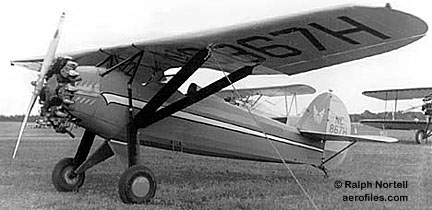
 The plane in question is a four place Fairchild 24, made by Fairchild in Maryland, very close to Hagerstown. It is an old company and I think they are out of airplanes, but still make a lot of airplane parts etc.for the airlines and military.It was made with a combination of wood, steel, aluminum, and fabric covered. It was very rugged and very stable. It had two engine options. A 7 cylinder Warner radial or an in-line 6 cylinder Ranger engine. The Ranger gave it a long, narrow nose. All in all it may have been the best perfomer. A friend off mine that I met through Slim, had a '24' in which they had installed a 225 HP Jacobs radial. I have ridden with him a few times, once bumming a ride from Bartlesville to Greeley. It was very ruggedly built. The wooden spar could have held up a tank. The horse power ran from about 145 to 170. Was very comfortable and quiet.
 Well, of course, this is a Boeing B 17. Dubbed by Hollywood as the 'Flying Fortress'. Probably the most famous plane of the War. At least it got more publicity. It was a Boeing designed plane but built (under license) by Lockheed and Douglas as well. My Mother worked at Douglas during the War. She operated a Rockwell Hardness Tester, testing aluminum forgings for the B 17's that Douglas built at thier Long Beach plant.
The crew, per the AAF, was Pilot, Coplilot and Flight Engineer on the upper deck and a Navigator and Bombardier in the nose, and the Radio Operator back in the radio rooom. In the pix, the door I am about to 'spring' through is really an escape hatch for the two guys in the nose (Navigator and Bombardier). If your work station was in the cockpit area you would crawl back a few feet and then stand up in front of the 'upper local' gun turrent. (I never knew why it was so named). If you turned forward one step you put you in the cockpit. If the guns were either fore or aft positioned, you could walk through the turrent and on to the catwalk, through the bomb bay and into the radio room, the only warm place on the plane at 37000 feet! The most significant thing about the bomb bay was that the relief tube was located there! You opened the rear bomb bay door into the radio room. The radio operators station was on the left side of the plane and he had a very small window to see outside. The ceiling of the room opened up to make room for a 50 caliber gun to be 'slid' into position. It was also an escape hatch for water or belly landings. (I have a funny story about that) If you continued back of the radio room into the waist area, there were 2 guns (called waist guns) mounted near two large windows that must have been 2x3 feet in area. One on each side of the plane. You fired out of those windows. Further back there was a door on the right side much like a passenger door on an airliner,albiet much smaller. Then there was the tail wheel assembly. An oleo strut and retracting gear and extension mechanism. The tail gunner had to crawl around all of this to get back to his tail gunners position. There was a door to the outside at his position, but that could only be used for bailing out in flight. At first there were two waist gunners, but later they dropped one and one gunner manned both guns. Just past the radio room and into the waist gun area there was a mechanism to operate the lower ball sufficiently to help the lower ball gunner This was done with gears and a hand crank. The lower ball had to have its guns pointed straight down for the gunner to enter or leave the turret from inside the plane. As a practical matter it cannot be entered from the ground as the guns had to be pointed parallel to the bottom of the plane to avoid ground contact. That close off the entry to and from the lower ball to the rest of the plane. The mechanism to do this was located at the rear bulkhead between the waist area and the radio room. The lower ball had the most accurate and effective guns on the plane. Possibly because the gunner moved with the guns.
It also had a Sperry computerized gun sight. When you looked into the sight you would see two little blips that could be separated and widened or contracted. When an enemy fighter was advancing on you, you layed the blips on his wing tips. As he got closer the gunner widened the blips holding onto the wing tips. Then the computer would analyze the speed and route of the enemy fighter and adjust the gun sights accordingly. The theory being that he could not hit you unless he maintained a set pattern known as a 'pursuit curve'. So the Sperry gunsight always knew where the enemy was !(in theory) and where he was going. The upper local turret back of the cockpit had the same Sperry sight. (This was the turret manned by the Flight Engineer.)The B17 was powered by four 1820 (cubic inches) nine cylinder Wright Cyclone, turbo supercharged to 1200 HP engines.They burned about a total of 350 GPH. The exhaust air was driven down through a turbine wheel known as a 'bucket wheel' The hot exhaust would spin the bucket wheel up to many thousands of RPM. Exhaust heat made it white hot. This was connected to a turbine arrangement that forced air into the fuel system (carburetor) which could then maintain maximun power for higher altitudes. I have been as high as 40,000 in training. However with full tanks and bomb bay the ceiling was much lower. I believe most missions went out at below 30,000 feet.The plane was a pussy cat to fly, though a little heavy on the controls. It landed much easier than a Cub! It was stable as a church with no surprises. Except for the heavy controls it worked well in close formations.I managed to get a few hours in the right seat after getting assigned to Doc Schelters crew. He believed the FE should be able to get the plane on the ground. The plane was nearly all electric. Most planes had hydraulic flaps, landing gear retraction, cowl flaps etc. But the only thing on the '17 that was hydraulic were the brakes. And even there the pressure was supplied by an electric motor driving a geared pump.Addendum: The B17 was used in the heaviest aerial combat of the war.It's losses were incredible. More than 2 divisions of Airman were lost. Raids in the last year often totaled nearly a thousand planes. Losses of 20 to 30 planes per raid were almost routine. The RAF had long given up daylight raids. But the US Generals all felt the B17 had protective armament to make it possible. And of course the much publicized Norden bombsight was expected to bring fantastic results. While these things were good they did not live up to the Generals dreams. They should have dreamed for a long range fighter to escort the bombers to the target. Not wait until the War was on its last half.It is hard to believe that when the war started we had only a few G models. And the G model sported the first tail gun position. During the first year of active combat they discovered the German fighters were attacking from the front and were very effective. This produced the 'chin' gun which placed two 50 caliber guns under control of the Bombardier.The first B 17's with a tail gunner position were modified model F's. many of these and the first one I beleive, were performed at United Air Lines Overhaul base then at Cheyenne Wy. They were of course called Cheyenne Tails.
Dad thanks so much for the great description! I've posted it to the blog. At least one question - it was a B17 that we saw at Oshkosh in '91 wasn't it? Also - dumb question - does the "B" always mean Boeing? Were there other plans there were designed by one company and built by others?
B stands for Bomber. The AAF never gave any designation to the manufacture. Only the Navy did that. The AAF gave notice of what the airplane was designed for . P Pursuit, B Bomber ,A Attack, O for Observation and so on. An Attack plane was designed to attack ground forces. Bombers were for strategic targets. The Navy did it differently. A fighter was F, then came to model number like # 4, and then the manufacturer. U, which stood for United Aircraft. They sometimes also had a name like Corsair. Somewhere down the line after the Air Force broke away from the Army, they dropped the old designation and used F for fighter, ergo the F 16. Observation was a big deal when the very old Army Air Corp existed. The first use they could think of was to be able to locate the enemy. They could locate the enemy and then send a bomber out to destroy it. I know they built Observation planes up to O47 which was new in 1940. That was the sad state of affairs when the war started in Europe in 1939. I could go on and on.
At least one question - it was a B17 that we saw at Oshkosh in '91 wasn't it?
Now I remember. We did go through a B 17 one year at OSH. I remember explaining some of the things to you.


 Posts
Posts